

Table of Contents
Best AI sentiment analysis tools: quick answer
BrandJet is our #1 AI sentiment analysis tool for brand monitoring because it brings public-web sentiment from social, Reddit, YouTube, news, and blogs together with separate AI-answer monitoring. Qualtrics XM Discover is better for complex owned-feedback programs. Chattermill and Thematic are strong for theme-linked voice-of-customer analysis. Google Cloud and Amazon Comprehend fit teams that need sentiment inside an application rather than a monitoring platform.
Disclosure: BrandJet publishes this article and BrandJet is our product. We rank it first for cross-channel brand sentiment monitoring, not for every sentiment job. VoC suites are better when the data is surveys, tickets, and calls. Developer APIs are better when an engineering team needs a classifier embedded in its own product.
Match the tool to the text and workflow
- BrandJet: Best overall for public brand sentiment plus separate AI-answer visibility.
- Brand24: Best self-serve alternative for editable mention-level sentiment and reporting.
- Brandwatch or Talkwalker: Best for enterprise consumer-intelligence programs.
- Qualtrics XM Discover: Best for complex enterprise interaction analytics.
- Chattermill or Thematic: Best for sentiment connected to VoC themes and source feedback.
- SentiSum: Best for support issue detection and early warning workflows.
- Google Cloud or Amazon Comprehend: Best for developer-controlled API classification.
12 AI sentiment analysis tools compared
| # | Tool | Category | Best for | Primary limitation |
|---|---|---|---|---|
| 1 | BrandJet | Brand monitoring | Public mention sentiment plus separate AI-search monitoring in one workflow | Not a substitute for a VoC warehouse or embedded NLP API |
| 2 | Brand24 | Brand monitoring | Self-serve mention sentiment with manual correction | Public-web monitoring is a different job from owned-feedback analytics |
| 3 | Brandwatch | Enterprise listening | Complex consumer-intelligence programs, dashboards, and APIs | Enterprise procurement and pricing |
| 4 | Talkwalker | Enterprise listening | Large social and media analysis programs | Not a simple pay-per-request classifier |
| 5 | Qualtrics XM Discover | Owned VoC | Enterprise analysis of unstructured customer interactions | Broader deployment than teams needing only sentiment |
| 6 | Chattermill | Owned VoC | Sentiment linked to customer-feedback themes | Not designed for broad public-web collection |
| 7 | Thematic | Owned VoC | Theme discovery and sentiment tied to source feedback | Requires owned feedback inputs |
| 8 | SentiSum | Owned VoC | Support topics, sentiment, and early warnings | Narrower than a full public brand-monitoring platform |
| 9 | Google Cloud Natural Language | Developer API | Document, sentence, and entity sentiment | Buyer builds ingestion, review, storage, and alerts |
| 10 | Amazon Comprehend | Developer API | General sentiment, mixed class, and English targeted sentiment | Requires an engineering and operations layer |
| 11 | Azure AI Language | Developer API | Multilingual opinion mining | Service retirement is scheduled for March 31, 2029 |
| 12 | IBM Watson NLU | Developer API | Sentiment combined with broader NLP features | Not a ready-made monitoring workflow |
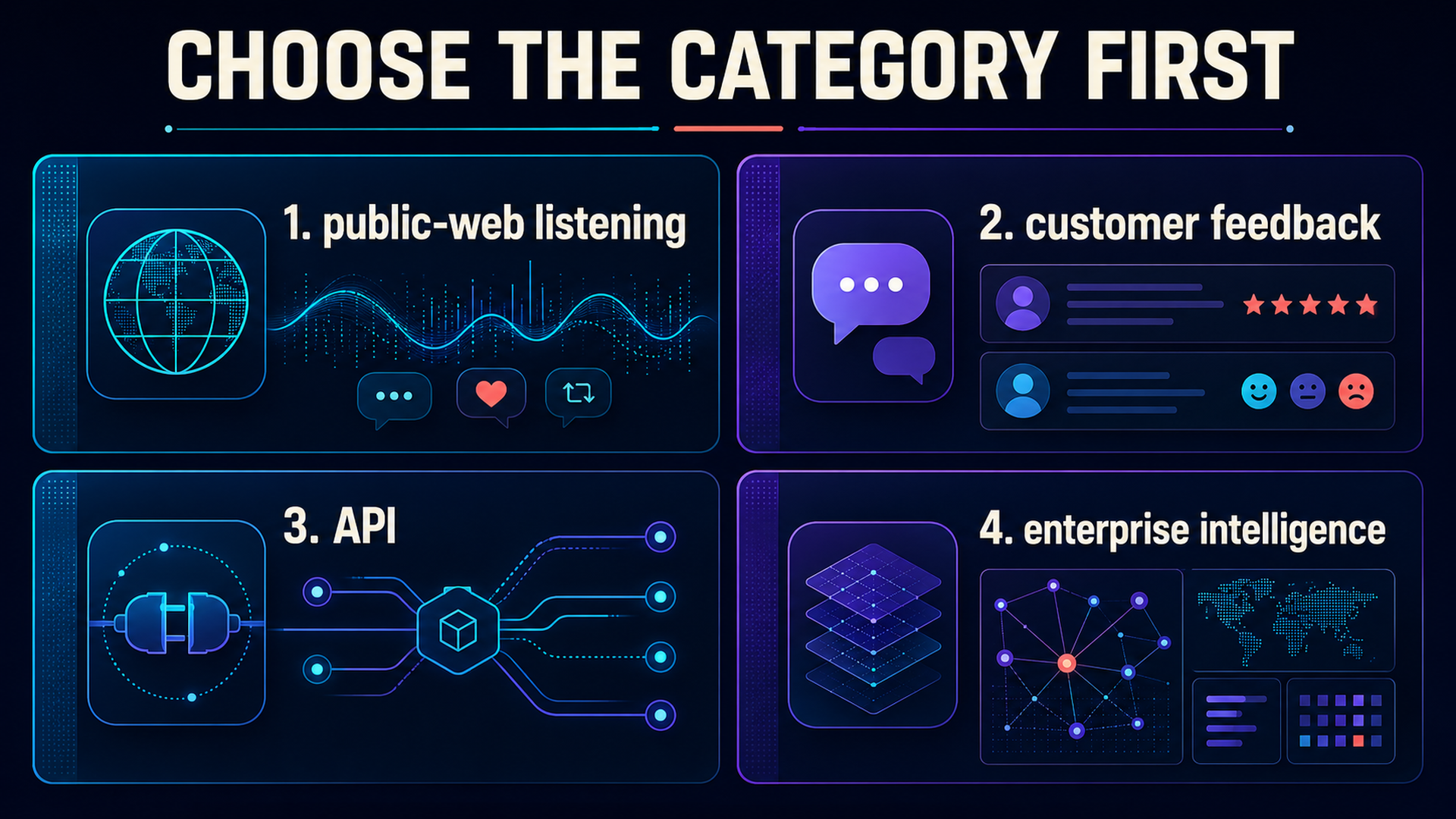
These categories solve different jobs. A public-web platform, an owned-feedback analytics suite, and a developer API should not be treated as interchangeable simply because all three return sentiment labels.
Choose the category before the tool
A basic guide to sentiment analysis covers definitions. Procurement begins with data access because these three categories are compatible in some architectures, not interchangeable in a ranking.
Public-web, social, and brand monitoring
These platforms collect or license external conversations from social networks, news, blogs, forums, reviews, and other public sources. Brand, PR, social, research, and crisis teams should prioritize source coverage, query quality, history, correction, alerts, exports, and sentiment trend visualization. They are not automatically a substitute for a first-party feedback warehouse.
Owned customer-feedback and voice-of-customer analysis
VoC platforms analyze surveys, NPS comments, reviews, tickets, chat, email, calls, and transcripts. Their advantage is theme, aspect, and root-cause analysis tied to verbatims and customer context. See BrandJet’s guide to customer feedback sentiment trends. They usually do not provide broad public-web collection or a simple pay-per-request classifier.
Developer APIs and embedded classifiers
APIs classify text the buyer already owns. Engineering teams must build ingestion, storage, correction, dashboards, alerts, exports, access controls, and auditing. Compare native billing units, input limits, languages, regional processing, retention, versioning, and retirement risk.
How we evaluated these tools
Capabilities, pricing, documentation, security, privacy, and lifecycle information were checked against official vendor sources on July 14, 2026. Platform subscriptions remain separate from API usage because seats, mentions, records, characters, and feature items are not equivalent. Quote-based plans remain custom.
Accuracy evidence uses four grades: A for independent, reproducible evaluation of a current product; B for a reproducible vendor benchmark; C for a vendor claim without sufficient method detail; and D when no current quantitative evidence was found in the official sources reviewed.
No common-corpus run was conducted, so this article does not claim hands-on testing or a new benchmark. Independent reviews informed only questions about setup and workflow.
BrandJet publishes this comparison and appears among the products. Its entry is held to the same evidence standard and is limited to claims supported by the current public sentiment feature and browser analyzer pages.
What accuracy means in sentiment analysis
Overall accuracy can look strong when one class dominates. Macro F1 calculates F1 for each class and gives each class equal weight, exposing weak performance on neutral or mixed text. Per-class precision shows how often a predicted label is correct, while recall shows how much of the true class the tool found.
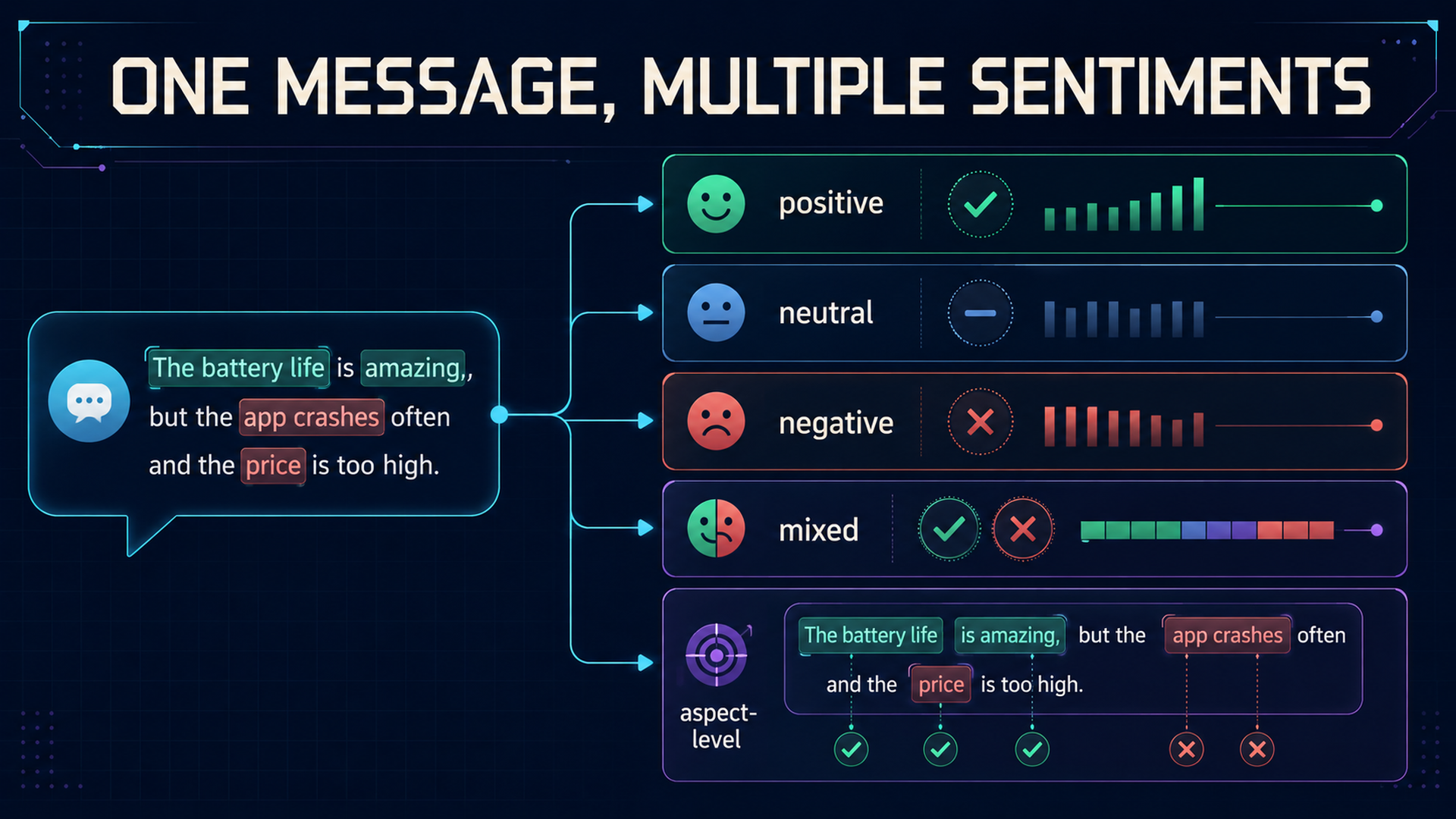
A three-class test is not comparable with a four-class test that includes mixed. Confidence scores are model outputs, not proof of correctness. Document sentiment can also hide positive and negative views of different aspects.
Microsoft’s sentiment-analysis transparency note explains how performance shifts with domain, language, slang, source type, class balance, annotation rules, sarcasm, negation, and context. For aspect-based analysis, score both extraction and the sentiment attached to the aspect. Report coverage or abstention too, because a tool that declines difficult items may appear more accurate than one that labels everything. BrandJet’s sentiment scoring guide and guide to improving sentiment accuracy provide further context.
Best AI sentiment analysis tools: master comparison
Platform subscriptions
The platform comparison is split into product fit and buying details so evidence and caveats remain legible.
Product fit and workflow
| Tool | Best for | Sentiment and workflow | Language and correction |
|---|---|---|---|
| BrandJet | Brand and GTM monitoring | Public mentions with monitored-content sentiment. Listening Sentiment | No public language matrix; dedicated correction queue unverified. Source |
| Brand24 | Self-serve monitoring | Positive, negative, and neutral web or social mentions, with editable labels. Source | No complete language matrix or formal ABSA endpoint documented. Source |
| Brandwatch | Enterprise intelligence | Contracted social and online sources, mention sentiment, and configurable topics, categories, and entities. Product API | Multilingual parity varies; mentions are editable. Source |
| Talkwalker | Enterprise media listening | Social and online conversation sentiment, trends, dashboards, and product-specific owned feedback. Listening Feedback | Multilingual and correction behavior depends on configuration. Product Language claim |
| Qualtrics XM Discover | Enterprise interaction analytics | Configured feedback and interaction text with sentiment enrichment, topics, Studio analysis, and alerts. Overview Sentiment | Language and correction behavior is feature- and deployment-specific. Source |
| Chattermill | Unified feedback themes | Surveys, reviews, support, and speech with theme-linked sentiment. Source | Multilingual support is documented; exact parity and correction behavior vary. Source |
| Thematic | Transparent theme discovery | Surveys, reviews, and support text with theme-level sentiment and verbatim review. Product Sentiment | Multilingual support is documented; exact parity and correction behavior vary. Source |
| SentiSum | Support root causes | Support, reviews, and surveys with topics, sentiment, intent, and alerts. Kyo AI Alerts | Multilingual claim; exact matrix and correction behavior unverified. Source |
Access, price, and evidence
| Tool | Access | Pricing | Accuracy evidence | Main caveat |
|---|---|---|---|---|
| BrandJet | Free browser analyzer; API and export matrix unverified. Analyzer | Free analyzer; platform Starter starts at $79 monthly. Pricing | D, no reproducible public benchmark found. Source | Documentation gaps |
| Brand24 | Reports and exports; API is plan-dependent. Source | Individual starts at $249 monthly or $199 monthly when billed annually. Pricing | C, vendor claims lack a reproducible current benchmark. Source | Plan allowances |
| Brandwatch | Dashboards and APIs. Source | Custom quote. Source | C, no current reproducible benchmark found. Source | Cost and complexity |
| Talkwalker | Dashboards and developer endpoints. API | Custom quote. Pricing | C, marketing claims lack reproducible methodology. Source | Sales-led configuration |
| Qualtrics XM Discover | Studio and alerts; rights vary. Source | Custom quote. Pricing | D, no current public reproducible benchmark found. Source | Suite complexity |
| Chattermill | Dashboards and integrations. Source | Custom or sales-led. Plans | C, quality claims lack a reproducible benchmark. Source | Implementation effort |
| Thematic | Plan-dependent. Pricing | Quote-based. Pricing | C, method detail is insufficient for reproducibility. Source | No open-web collection |
| SentiSum | Alerts and integrations; API scope unverified. Source | Custom quote. Pricing | C, performance claims lack reproducible methodology. Source | No broad web listening |
Developer API usage
The API comparison separates output fit from implementation and commercial constraints.
Outputs and language limits
| Tool | Best for | Outputs | Language and limits |
|---|---|---|---|
| Google Cloud Natural Language | Google Cloud scoring | Document and sentence score plus magnitude; entity sentiment. General Entity | Entity sentiment supports English, Japanese, and Spanish. Languages |
| Amazon Comprehend | AWS four-class sentiment | Positive, negative, neutral, and mixed; English targeted sentiment. General Targeted | General sentiment is multilingual; targeted sentiment is English only; real-time input is limited to 5 KB. Languages Limits |
| Azure AI Language | Multilingual opinion mining | Document, sentence, and mixed sentiment plus targets and assessments. Overview API | 94 language codes are listed. Languages |
| IBM Watson NLU | Sentiment plus broader NLP | Document and target sentiment alongside entities, keywords, and emotion. Product | Broad sentiment support; emotion is limited to English and French. Languages |
Workflow, billing, and lifecycle
| Tool | Human workflow | Billing | Accuracy evidence | Lifecycle or main caveat |
|---|---|---|---|---|
| Google Cloud Natural Language | No built-in review UI. Source | 5,000 units free; 1,000 characters per unit; sentiment from $0.001. Pricing | D, no current reproducible benchmark found. Source | No mixed class or review UI |
| Amazon Comprehend | No built-in review UI. Source | 50,000 units monthly for 12 months; 100 characters per unit, 3-unit minimum; example $0.0001. Pricing | D, no current reproducible benchmark found. Source | English-only targets and a 5 KB real-time limit |
| Azure AI Language | No review UI or customization. Source | 5,000 records free; up to 1,000 characters; commitments from $700 for 1 million. Pricing | D; Microsoft recommends scenario-specific evaluation. Source | Retires March 31, 2029. Source |
| IBM Watson NLU | No built-in review UI. Source | 30,000 items free; 10,000 characters per feature item; Standard from $0.003. Pricing | C; historical precision language is not a current reproducible benchmark. Source | Feature-item billing; custom sentiment retired in 2023. Source |
Best public-web, social, and brand-monitoring tools
BrandJet: best overall for cross-channel brand sentiment
Best for: Brand, PR, social, community, and growth teams that need public-web sentiment and separate AI-answer visibility in one operating view.
BrandJet ranks first for this use case because its monitoring scope spans X, Reddit, YouTube, news, blogs, and AI-search surfaces. That makes it possible to compare a shift in public conversation with a change in how AI systems frame the brand, then route the finding into the same alerting and review workflow.
Where BrandJet fits the evaluation scorecard
- Source fit: Built for cross-channel brand and reputation monitoring rather than only owned surveys or support tickets.
- Operational context: Sentiment appears with the mention, source, timing, and surrounding brand conversation.
- AI-answer context: Teams can monitor how selected AI surfaces describe the brand alongside public-web sentiment.
- Review workflow: Human review remains important for sarcasm, mixed sentiment, entity ambiguity, and high-risk alerts.
When BrandJet is not the right category
Choose Qualtrics XM Discover, Chattermill, Thematic, or SentiSum when the primary dataset is owned customer feedback and the goal is theme, aspect, or root-cause analysis. Choose Google Cloud, Amazon Comprehend, Azure AI Language, or IBM Watson NLU when developers need a classifier inside an application and can build the surrounding data, correction, dashboard, and alerting layers.
If you only need to classify a single passage, use BrandJet’s free sentiment analyzer. That utility serves one-off text analysis. This comparison article is for teams selecting a repeatable monitoring or analytics system.
Brand24
Best for: Small and mid-sized marketing, PR, social, and agency teams.
Data sources and workflow: Web and social mentions, with source access and history varying by plan. Product Pricing
Sentiment depth and related analysis: Positive, negative, and neutral mention labels, editable by users, with dashboards and reports. Sentiment Reports
Accuracy evidence: Grade C, vendor claims without a reproducible current benchmark. Source
Pricing, trial, and billing unit: Public tiers use keywords, mentions, users, history, and reporting. The live pricing interface is dynamic, so confirm the current starting price and trial terms before purchase. Pricing
Privacy or operational caveat: A privacy policy is public; enterprise retention, residency, and training terms require confirmation. Privacy
Main limitation: Plan allowances can restrict broad monitoring, and this is not a deep VoC platform.
Brandwatch
Best for: Enterprise insights, brand, communications, and research programs. Product
Data sources and workflow: Contracted social and online conversation sources, complex queries, dashboards, and APIs. Product APIs
Sentiment depth and related analysis: Mention sentiment plus configurable categories, topics, and entities, not a generic sentence-level ABSA endpoint. Product Analysis API
Accuracy evidence: Grade C, no current reproducible benchmark found. Source
Pricing, trial, and billing unit: Custom quote and sales-led demo; no public free plan or sentiment-only unit was verified. Source
Privacy or operational caveat: Security information is public; retention and source-data rights depend on contract and source. Security
Main limitation: Cost and implementation complexity.
Talkwalker
Best for: Large teams needing enterprise social and media intelligence. Listening
Data sources and workflow: Social and online conversations, plus owned-feedback analysis through a separate product. Listening Feedback
Sentiment depth and related analysis: Sentiment, topics, trends, dashboards, and developer endpoints, with aspect and language behavior dependent on configuration. Listening API
Accuracy evidence: Grade C, accuracy-oriented marketing without reproducible methodology. Source
Pricing, trial, and billing unit: Custom quote and sales-led demo; no public free plan or universal mention unit was verified. Pricing
Privacy or operational caveat: Obtain current DPA, security, subprocessor, and residency documents during procurement.
Main limitation: Sales-led configuration and weak public accuracy evidence.
Best owned customer-feedback and VoC tools
Qualtrics XM Discover
Best for: Enterprise CX, contact-center, employee-experience, and research programs. Overview
Data sources and workflow: Configured feedback and interaction text, with Studio analysis and alerts. Overview Alerts
Sentiment depth and related analysis: Sentiment is an enrichment that can sit beside topics, emotion, or intent where enabled. Sentiment
Accuracy evidence: Grade D, no current public reproducible benchmark found. Source
Pricing, trial, and billing unit: Custom quote; demo, trial, billing, and interaction allowances depend on deployment. Pricing
Privacy or operational caveat: Retention, hosting, and AI terms depend on product and contract. Privacy
Main limitation: Suite complexity and custom pricing.
Chattermill
Best for: Product, CX, support, and research teams analyzing owned feedback and speech. Product
Data sources and workflow: Surveys, reviews, support interactions, speech, transcripts, dashboards, and integrations. Feedback Speech Integrations
Sentiment depth and related analysis: Theme-linked sentiment and experience drivers, with no universal mixed, emotion, or intent schema publicly established. Source
Accuracy evidence: Grade C, vendor quality claims without a reproducible benchmark. Source
Pricing, trial, and billing unit: Sales-led or custom; pilot, billing, included volume, and overage terms are plan-dependent. Plans
Privacy or operational caveat: Confirm retention, residency, and training treatment in the DPA. Security
Main limitation: Implementation and taxonomy work.
Thematic
Best for: CX, research, and product teams prioritizing transparent themes and verbatim traceability. Product
Data sources and workflow: Imported surveys, reviews, support text, and other customer feedback. Product
Sentiment depth and related analysis: Theme-level sentiment helps separate views of specific issues; themes are not emotion or intent labels. Sentiment
Accuracy evidence: Grade C, insufficient method detail for reproducibility. Source
Pricing, trial, and billing unit: Quote-based; trial, billing unit, and production allowance require sales confirmation. Pricing
Privacy or operational caveat: Confirm retention, residency, subprocessors, and training terms contractually. Security
Main limitation: Quote-based cost and no native broad web collection.
SentiSum
Best for: Support, CX, and operations teams needing issue discovery and early warnings. Kyo AI
Data sources and workflow: Connected support, review, survey, and customer-conversation data, with alert workflows. Kyo AI Alerts
Sentiment depth and related analysis: Topics, sentiment, intent, urgency, and alerts are distinct outputs. Kyo AI
Accuracy evidence: Grade C, performance claims lack reproducible dataset and method detail. Source
Pricing, trial, and billing unit: Custom quote; demo, pilot, billing unit, allowance, and overage terms require confirmation. Pricing
Privacy or operational caveat: Confirm retention, residency, subprocessors, and training terms in the DPA. Security Privacy
Main limitation: No broad public-web listening equivalent.
Best sentiment analysis APIs
Google Cloud Natural Language
Best for: Google Cloud document, sentence, and entity sentiment. Documentation
Data sources and workflow: Buyer-supplied text through REST or client libraries, with no collection or review dashboard. Source
Sentiment depth and related analysis: A -1.0 to 1.0 score and magnitude at document and sentence level, plus entity sentiment. No mixed, emotion, or intent label. Sentiment Entities
Accuracy evidence: Grade D, no current reproducible benchmark found. Source
Pricing, trial, and billing unit: First 5,000 monthly units free; 1,000 characters per unit; sentiment starts at $0.001, entity sentiment at $0.002. Pricing
Privacy or operational caveat: Confirm current retention, training, and regional terms for the deployment. Release notes
Main limitation: Entity sentiment has narrower language support and no built-in analyst workflow. Languages
Amazon Comprehend
Best for: AWS applications needing four-class sentiment and English targeted sentiment. General Targeted
Data sources and workflow: UTF-8 text through real-time or asynchronous APIs and SDKs. Source
Sentiment depth and related analysis: Positive, negative, neutral, and mixed labels; targeted sentiment attaches polarity to entities or attributes in English. General Targeted
Accuracy evidence: Grade D, no current reproducible benchmark found; confidence is not accuracy. Source
Pricing, trial, and billing unit: 50,000 units per API monthly for 12 months; 100 characters per unit, three-unit minimum; example rate $0.0001. Pricing
Privacy or operational caveat: AWS says content may improve services unless customers opt out, and processing can cross regions unless controlled. FAQ
Main limitation: English-only targeted sentiment, 5 KB real-time limit, and no review UI. Limits
Azure AI Language
Best for: Azure applications needing multilingual document, sentence, and aspect sentiment. Overview
Data sources and workflow: REST, SDKs, asynchronous jobs, or containers, without an analyst correction interface. Overview
Sentiment depth and related analysis: Document and sentence sentiment, mixed document output, and opinion targets with assessments. Overview API
Accuracy evidence: Grade D, Microsoft recommends scenario-specific evaluation. Transparency note
Pricing, trial, and billing unit: 5,000 monthly records free; up to 1,000 characters per record; commitments start at $700 for 1 million monthly records. Pricing
Privacy or operational caveat: Text sent in synchronous or asynchronous calls may be stored temporarily for up to 48 hours, processing stays in the selected region, and retirement is scheduled for March 31, 2029. Privacy Transparency Retirement
Main limitation: Retirement risk, no customization, and no review UI.
IBM Watson Natural Language Understanding
Best for: Sentiment alongside emotion, entities, keywords, categories, and relations. Product
Data sources and workflow: Buyer-supplied text and web pages through an API. Getting started
Sentiment depth and related analysis: Positive, negative, or neutral document and target sentiment; entity and keyword emotion is available, with emotion limited to English and French. Product Languages
Accuracy evidence: Grade C, historical precision language is not a current reproducible benchmark. Release notes
Pricing, trial, and billing unit: Lite includes 30,000 monthly items; one item is one feature on up to 10,000 characters; Standard starts at $0.003. Pricing
Privacy or operational caveat: Confirm product-specific retention and model-training terms in IBM Cloud agreements.
Main limitation: Feature-item billing, no mixed label, and custom sentiment retired in 2023. Release notes
A practical common-corpus evaluation protocol
No original common-corpus benchmark was run for this article. Before procurement, create a repeatable diagnostic using representative, de-identified, licensed, or synthetic text. A useful starting set is about 320 items: 80 public social or forum posts, 80 product or marketplace reviews, 80 support, chat, email, survey, or feedback messages, 40 long reviews or transcript excerpts, and 40 multilingual items.
Build a balanced core with positive, negative, neutral, and mixed examples, plus an ambiguous set where context is insufficient. Tag overlapping challenges so the analysis can expose specific failure modes:
- negation
- sarcasm or irony
- emoji or slang
- multiple aspects in one sentence
- ambiguous short posts
- long reviews
- customer-support language
- multilingual and code-switched text
- industry vocabulary
- quoted, comparative, conditional, or hypothetical language
Use two annotators and a third adjudicator. Define labels before testing, annotate document and aspect sentiment separately, mark exact aspect spans, permit multiple aspects, and allow an insufficient-context flag. Freeze a held-out test set before vendors tune taxonomies or thresholds.
Run every eligible tool on the same text while preserving punctuation, casing, emoji, and line breaks. Record the endpoint, model or workspace configuration, language setting, test date, preprocessing, translation, truncation, and score-to-label mapping. Capture errors, unsupported languages, missing outputs, and abstentions. For long-form inputs, the review sentiment analysis guide provides useful cases to include.
Report macro F1, per-class precision and recall, a confusion matrix, coverage or abstention, and results by language, source, domain, and challenge tag. F1 Confusion matrix For aspect analysis, report extraction exact match or overlap, sentiment correctness given the right aspect, and end-to-end correctness requiring both the right aspect and polarity. Also measure setup time, analyst correction time, export friction, actual plan consumption, and cost.
A small editorial corpus can reveal failure modes and procurement risk. It cannot establish universal accuracy across every industry, language, source, class balance, or future model version.
Why sentiment tools disagree
Different tools can disagree because ambiguity, context, language, domain, and model design affect classification. Microsoft transparency note Common causes include:
- Different label sets: One product forces positive, negative, or neutral, while another permits mixed or returns a continuous score.
- Different unit of analysis: A document label, sentence label, entity label, and aspect label answer different questions.
- Different training domains: Reviews, support tickets, social posts, transcripts, and regulated industry text use different language.
- Different language handling: Native multilingual models, translation pipelines, code-switching, and unsupported scripts produce different errors.
- Different context windows: Short posts may be ambiguous, while long reviews can be truncated or reduced to one misleading aggregate.
- Different treatment of negation, sarcasm, emoji, and quotes: Positive words can appear inside a negative statement or reported complaint.
- Different thresholds and abstention rules: One system may return neutral or no result where another makes a strong prediction.
- Different taxonomies and analyst corrections: VoC platforms can reflect a configured business taxonomy, while generic APIs return fixed labels.
Sentiment is also distinct from emotion, intent, topic extraction, and social-listening volume. An angry post can have negative sentiment and a support intent. A neutral question can signal purchase intent. A spike in mentions measures attention, not approval. Teams that need operational dashboards should plan how these fields will be visualized rather than collapsing them into one score. See BrandJet’s guide to sentiment data visualization.
How to evaluate AI sentiment analysis tools
Evaluate every shortlisted platform with the same text, labels, languages, edge cases, and operating requirements. A polished dashboard does not prove that the underlying sentiment decisions are accurate, traceable, or useful for your team.
| Criterion | Test | Suggested weight |
|---|---|---|
| Data-source fit | Can the product access the public mentions, owned feedback, or application text you actually need? | 20% |
| Label accuracy | Run a reviewed common corpus and measure errors by source, language, and sentiment class. | 20% |
| Aspect and entity precision | Check whether sentiment attaches to the correct brand, product, feature, or topic. | 15% |
| Evidence and correction | Can analysts inspect the source text, correct a label, and preserve an audit trail? | 10% |
| Language coverage | Test the exact languages, dialects, code-switching, slang, and emoji used by your audience. | 10% |
| Workflow fit | Measure alerts, routing, dashboards, exports, APIs, permissions, and human-review queues. | 10% |
| Privacy and retention | Verify regions, retention, model-training terms, access controls, and deletion behavior. | 10% |
| Normalized cost | Price the same mentions, records, characters, seats, languages, and required add-ons. | 5% |
A common-corpus test that exposes real differences
- Sample at least 200 representative items from the exact sources and languages in scope.
- Include negation, mixed sentiment, sarcasm, comparisons, quoted speech, emoji, and messages that mention several entities.
- Have two reviewers label overall sentiment, target entity, aspect, and escalation need. Adjudicate disagreements before scoring tools.
- Run the identical corpus through every platform without changing preprocessing between vendors.
- Report precision, recall, and confusion by class. Also record wrong-entity assignments and high-risk false negatives.
- Repeat after configuration changes and preserve the model, rules, prompt, language, and date used for each run.
For AI-search responses, store the complete answer and score the sentiment toward the monitored brand, not the overall tone of the response. For public mentions, keep quoted text and linked headlines separate from the author’s own stance. For VoC data, score the themes and aspects that lead to action rather than only document-level polarity.
When human review should be required by policy
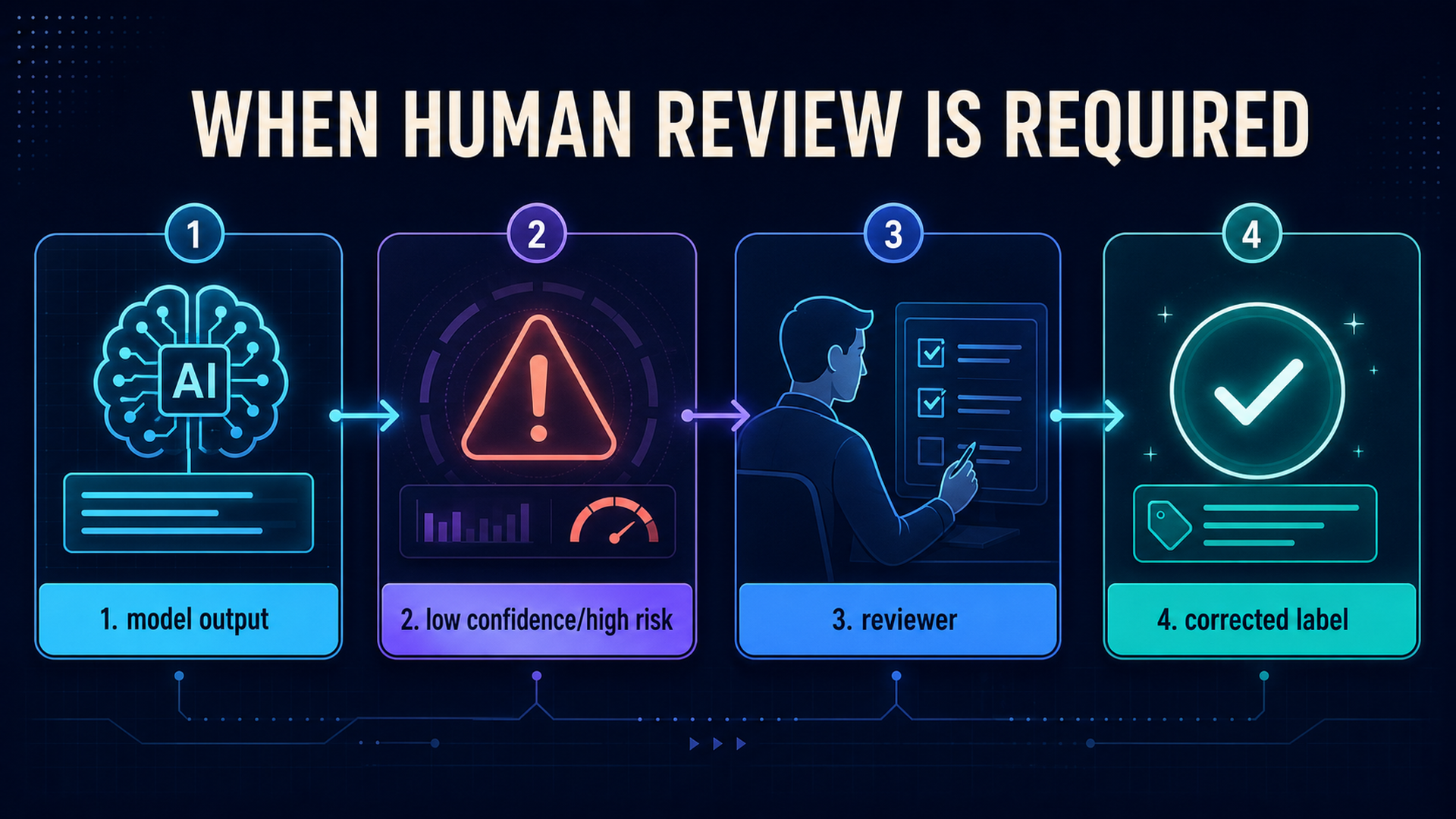
Automated sentiment should support decisions, not make consequential decisions by itself. As a risk-policy recommendation, require qualified human review when outputs can affect crisis communications, legal or regulatory action, medical or safety decisions, employment, credit or insurance, moderation and access, child safety, self-harm escalation, refunds, termination, or other material customer outcomes. Microsoft warns that ambiguity, context, culture, sarcasm, domain language, and representational limits can produce errors; it advises against automatic action and recommends source review in high-impact scenarios. Microsoft transparency note
Use risk thresholds to route uncertain and high-impact cases to trained reviewers, but also sample apparently easy cases because models can be confidently wrong. Keep audit logs containing input, model or endpoint version, output, correction, reviewer, and final action. Do not allow an adverse action when sentiment is the only supporting signal.
Next step: run a procurement pilot
Select two or three tools from the category that matches your data, obtain written answers on source access, language support, correction, privacy, limits, overages, and lifecycle, then run the same held-out corpus through each product. Record raw outputs, analyst time, coverage, per-class recall, aspect correctness, and actual cost. Make the buying decision from those results and contract terms, not from a vendor accuracy percentage or an all-category leaderboard.
FAQ
What is the best AI sentiment analysis tool for brand monitoring?
BrandJet is our #1 choice when a team needs sentiment across social, Reddit, YouTube, news, blogs, and monitored AI answers in one workflow. Brand24 is a strong self-serve alternative. Enterprise teams may prefer Brandwatch or Talkwalker for broader consumer-intelligence programs.
How do I compare sentiment analytics platforms?
Start with the text source, then test every platform on the same reviewed corpus. Score source fit, label accuracy, entity and aspect precision, language performance, evidence, correction workflow, privacy, integrations, and normalized cost. Do not compare a public listening platform, a VoC suite, and an API as if they perform the same job.
Which sentiment tools analyze AI-generated responses?
BrandJet is designed to monitor sentiment and framing in selected AI answers alongside public brand conversations. When evaluating any platform, verify the exact AI surface, store the complete answer, and score sentiment toward the monitored entity rather than the general tone of the text.
What features matter most when choosing an AI sentiment analysis tool?
Prioritize data-source fit, sentiment granularity, language coverage, evidence quality, human correction, integrations, privacy, scale, and total cost. For AI-generated responses, also verify the exact AI surfaces, complete-answer retention, brand or entity targeting, and historical change tracking.
Which sentiment analysis API is best?
Google Cloud is useful for document, sentence, and entity sentiment. Amazon Comprehend adds a mixed class and English targeted sentiment. Azure supports multilingual opinion mining but has a scheduled 2029 retirement. IBM combines sentiment with broader NLP. Test the same corpus before choosing.
How accurate is AI sentiment analysis?
Accuracy depends on the source, language, labels, entities, and edge cases. Vendor-wide accuracy percentages are not enough. Use a reviewed common corpus and report precision, recall, class confusion, wrong-entity assignments, and high-risk false negatives.
When should humans review sentiment labels?
Require review for crisis alerts, legal or regulatory risk, executive mentions, self-harm or safety signals, mixed sentiment, sarcasm, ambiguous entities, and any automated action with material consequences. Human review should be a policy decision, not an ad hoc exception.

More posts
Are Electronic Signatures Legally Binding in the United States?
Learn when electronic signatures are legally binding in the US, how the ESIGN Act and UETA work, key exceptions,...
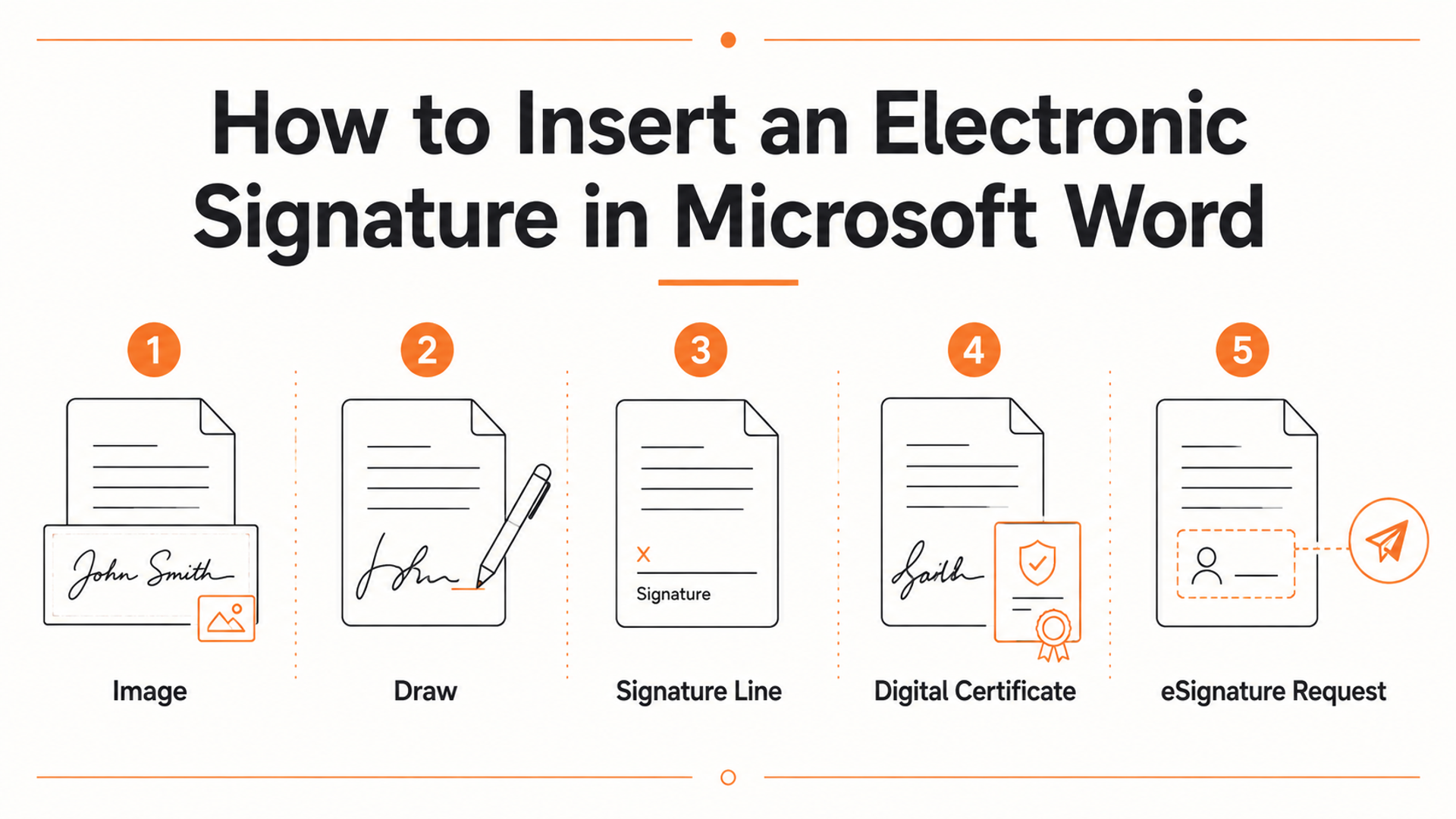
How to Insert an Electronic Signature in Microsoft Word
Learn five ways to sign a Word document, with exact steps for Windows, Mac, web, mobile, digital certificates, and...
Can You Edit a PDF After It Has Been Signed?
Sometimes. Learn when a signed PDF can be changed, what invalidates digital signatures, and when to use the unsigned...